


Context Drift in AI Systems
Posted in Agile Development, Artificial Intelligence, Business Analysis, Change Management, eLearning Courses, Product Development on 7th August 2026
Maintaining Reliability as Data, Assumptions, and Operational Conditions Change
An AI workflow can continue running perfectly while becoming progressively less useful
Nothing crashes. The automation still triggers. The model still responds. The output may be well written and technically correct. Yet somewhere between deployment and everyday use, the conditions the system was designed around have changed. A priority has shifted. A process has been updated. New information has replaced an older assumption. The people using the workflow now expect something different from what they expected three months ago. The system continues doing exactly what it was designed to do.That is the problem.
In AI-assisted workflows I have worked with, reliability has rarely been only about whether the technology functions. The more difficult question is whether the context surrounding that technology is still valid.I think of this as context drift.It is different from the model drift usually discussed in machine learning. The model itself may not have changed at all. What has changed is the environment in which its outputs are being interpreted and used.This distinction becomes important once AI moves into recurring operational work.
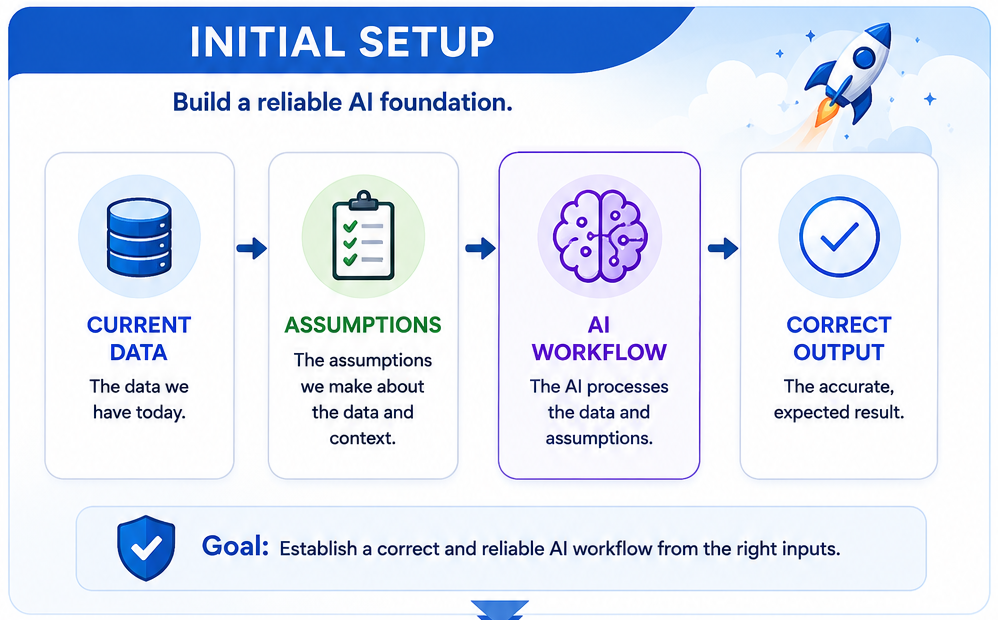
Consider a workflow designed to prepare communications based on an agreed set of priorities. When it is created, the instructions are accurate, the reference material is current, and the expected output is clear. For several weeks, the system performs exactly as intended. Then something changes. Perhaps the audience changes. A program moves into a different phase. A stakeholder asks the team to prioritise a different message. An internal process is revised, or a piece of information that the workflow relies on is no longer current.Unless that change reaches the AI workflow, the system has no reason to behave differently. The result may still look convincing.That is what makes context drift particularly difficult.
A broken workflow is easy to notice. A workflow operating against outdated assumptions can continue producing polished outputs for a long time. I encountered this while working with recurring AI-assisted processes. Initially, much of my attention went into getting the workflow right - defining the instruction, providing appropriate context, deciding how information should move through the process, and checking the quality of the result. Over time, I realised that the harder problem came after that work was finished. The workflow did not exist in isolation. It depended on information, priorities and assumptions outside the AI system. Some of those changed faster than the workflow did. Improving the prompt did not solve that problem.
The prompt could be perfectly written and still describe yesterday’s reality.
This changed the way I started thinking about AI reliability. Instead of treating context as something supplied once during implementation, I began treating it as something that needed to be checked throughout the life of the workflow. That means understanding what the system depends on. Some dependencies are obvious, such as reference documents, structured data, or user inputs. Others are less visible: who currently owns a decision, which version of a process is active, what was recently agreed, which exceptions have already been made, or whether a previously valid instruction should still be followed.
The more operational an AI system becomes, the more these dependencies matter. A useful first step is simply making them visible. If a workflow relies on a particular source of information, that source should be identifiable. If it depends on an assumption, there should be a way to recognise when that assumption is no longer safe. If certain instructions have a limited lifespan, they should not remain embedded indefinitely without review.
In practical terms, this can be surprisingly simple:
- A workflow can compare the current state with the previous one before taking an action
- A knowledge source can carry a review date
- A material change in an input can trigger human confirmation rather than automatic execution
- A recurring process can periodically ask whether the conditions it was designed around still hold
- A system can flag conflicting information instead of quietly choosing one version None of these mechanisms make the underlying AI more intelligent. They make the surrounding system more aware of change.
That distinction matters.
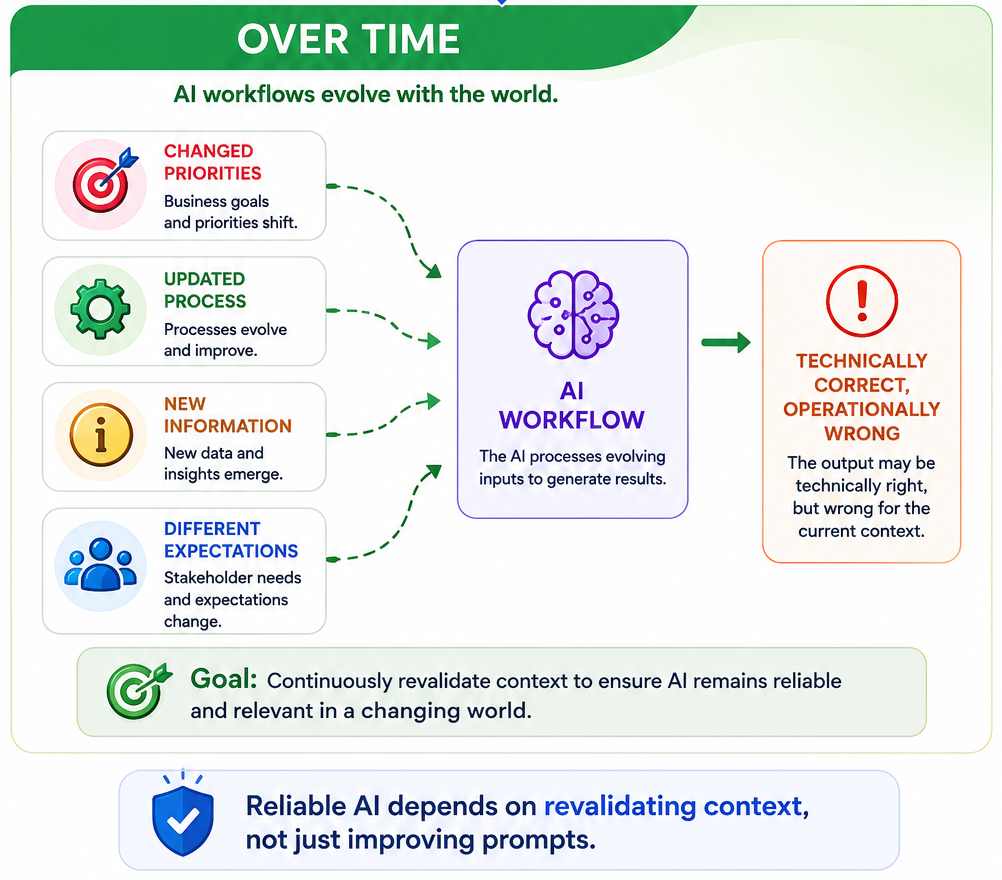
There is a tendency to respond to disappointing AI performance by improving the model, rewriting the prompt, or supplying more instructions. Sometimes that is necessary. But if the real problem is that the operating context has changed, improving the answer-generation layer only makes the system more efficient at responding to outdated conditions.
A technically stronger answer can still be operationally wrong.
This becomes even more important as AI workflows become persistent. A person using a chatbot occasionally brings fresh context into the conversation almost automatically. They know what happened yesterday. They know that a deadline moved. They remember a conversation that changed the direction of the work. A persistent workflow does not necessarily receive those updates.It may continue running in the background using the last version of reality it was given.
The reduction in manual involvement therefore creates a new responsibility: the system needs a way to recognise when its context may no longer be trustworthy.This does not mean every change should stop the workflow. Doing that would create an automated system that constantly asks for permission and eventually becomes more cumbersome than the process it replaced.The challenge is deciding which changes matter enough to require attention.
In one AI-assisted operational process, I found that monitoring every individual input created unnecessary noise. What mattered more was identifying changes that affected the assumptions behind the workflow. A routine variation could continue through the normal process: a change affecting the expected outcome, stakeholder requirement, or decision context needed review.That is a more useful distinction than simply treating every deviation as an exception. It also changes the role of monitoring.Monitoring is often understood as checking whether a system is available or whether an automation completed successfully. For AI workflows, that is only one part of the picture.
A workflow can report 100% successful execution while producing increasingly irrelevant results.
Operational monitoring therefore needs to include the environment around the system.
- Are the reference sources still current?
- Are human corrections increasing?
- Are people regularly rewriting outputs that previously required little adjustment?
- Are the same types of recommendations being overridden?
- Has the workflow’s input changed significantly from the conditions it was originally designed for?
These signals can reveal deterioration before the system visibly fails. Human behaviour is particularly useful here. If people repeatedly correct the same type of output, the immediate temptation is to treat each correction as a separate issue. A better question is whether those corrections are telling us that the workflow’s understanding of the operating environment is becoming outdated.
The correction is not just a fix. It is information about the system.
This is where feedback becomes valuable. A reliable AI workflow should not merely generate outputs and move forward. It should create enough visibility for its assumptions to be challenged over time. That might mean reviewing repeated overrides, checking where escalations are increasing, looking at the difference between generated outputs and approved outputs, or identifying parts of the workflow that now require more human intervention than they did previously.The purpose is not constant optimisation. It is revalidation.
There is an important difference. Optimisation asks how the system can perform the existing task better. Revalidation asks whether the system should still be performing the task in the same way.As organisations build more AI into recurring operations, I think the second question will become increasingly important.
Deployment creates a snapshot of alignment between a system and its environment. It does not guarantee that alignment will remain.
- Processes change
- Knowledge changes
- People change
- Priorities change
AI systems need to operate in that reality.
The organisations that manage this well will not necessarily be the ones constantly replacing models or rewriting prompts. They will be the ones that build simple mechanisms for detecting when the assumptions around their AI systems are beginning to move.Reliable AI is therefore not only about producing the right answer. It is about ensuring that the system is still answering the right question, using the right context, for the reality that exists now.
 ® and Analyst Zone® © Since 2017 Texavi Innovative Solutions