


Decision Architecture in the Age of AI
Posted in Agile Development, Artificial Intelligence, Business Analysis, Change Management on 18th June 2026
Why Better AI Will Never Replace Better Organisational Decisions
Most organisations investing in AI are optimising most of the AI in the next decade; they probably have the right layers. They are improving the quality of answers while ensuring decisions remain of high quality; implementations trace back to that gap being conflated it's not a fault of unmodified technology. AI can generate a recommendation in seconds, but it cannot determine whether an organisation should accept, challenge, escalate, or ignore that recommendation. That work still belongs to people, and it still depends on context, ownership, and judgement.
This article by Rohit Mahadevu, AI and Digital Transformation Consultant at Texavi Innovative Solutions, introduces Decision Architecture. It is not a framework to install, but a way of noticing how decisions actually move through an organisation once AI becomes part of the process. The argument is simple. AI is changing how answers get produced. It has not changed how organisations decide what to do with it. That gap is where the real advantage now sits.
A team receives an AI-generated recommendation. The output is confident, well-structured, and arrives faster than anything a human could have produced. Everyone in the room reads it. Nobody quite knows what happens next.
Does it get implemented as written? Does someone senior need to sign off? Does it need testing first? Should someone with domain knowledge be allowed to overrule it, and on what basis? In most organisations I have worked with, nobody has actually answered these questions. They assumed the answer would become obvious once the AI system was effective enough. It rarely does. The recommendation was never the hard part. The challenging part was deciding how to use the recommendation.
The Illusion of Better Decisions
There is a quiet assumption running through most AI adoption efforts: that better outputs will eventually produce better outcomes. More data, faster processing, sharper recommendations the logic suggests that decision quality will improve as a natural side effect.
I have not seen this assumption hold up in practice. I have watched teams receive genuinely useful AI output and still make the same decisions they were making before, for the same reasons: unclear ownership, conflicting incentives, an unwillingness to challenge a plausible-sounding answer, or simply no agreed process for what "accepting" a recommendation actually means.
Speed can even work against decision quality, and I saw this phenomenon directly on a digital transformation project where we built AI-assisted workflows to support operational decisions and produce content far faster than the manual process it replaced. "Would we do it again?" As confidence in the system grew, something shifted that nobody had planned for: people started accepting AI-generated drafts and recommendations with noticeably less discussion than they'd have given the same work coming from a colleague.
The outputs were well structured, professionally written, and arrived almost instantly and that combination created an impression of certainty that hadn't actually been earned. When we made a point of slowing down and reviewing some of those recommendations properly, the problem was rarely factual accuracy. It was context. The system had no awareness of a recent conversation, a shifting priority, or some subtle factor bearing on the decision that week. The lesson that stuck with me is that AI can speed up how fast a recommendation gets produced, but it should never speed up how fast people stop questioning it.
Introducing Decision Architecture
Decision Architecture is the intentional design of how decisions are supported, questioned, escalated, reviewed, and ultimately owned once AI becomes part of the work. I use the term loosely, almost as a habit of mind rather than a method – a way of asking, before any AI system goes live, who is accountable if this recommendation turns out to be wrong and how anyone would actually know that in time to do something about it.
I have deliberately avoided turning the concept into a five-stage model with a scorecard attached, mainly because the moment something like this becomes a rigid structure, people start designing around it rather than thinking through it. What the lens does is force a distinction that most organisations skip past without noticing: the difference between a recommendation and a decision. AI produces the first. People, operating inside some structure of accountability, produce the second. Most of the friction I have run into on real implementations traces back to that gap being conflated – not a fault in the technology but an assumption that a good answer settles the matter on its own.
AI reduces the effort required to generate answers. It does not reduce the responsibility required to choose between them.
Designing Better Decisions
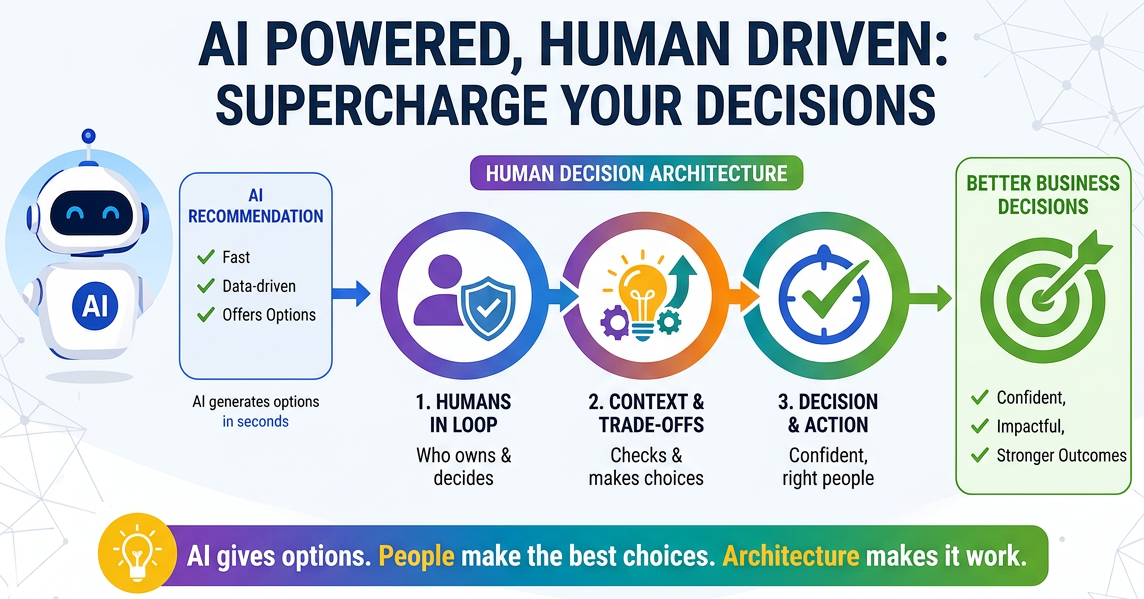 Once you start designing decisions instead of assuming them, a few practical questions become unavoidable.
Ownership It is the first aspect that often surprises people. On a digital transformation project I worked on, the technical side of an AI-assisted workflow came together without much drama, the system generated solid recommendations, drafted communications competently, and automated the routine steps it was supposed to automate. The problems started once it was actually working. Nobody had settled who was meant to review, approve, or push back on the outputs before they were acted on, so everyone assumed someone else was doing it. The technology was fine throughout. What was missing was a person whose job it clearly was to catch a faulty recommendation before it went anywhere. That changed how I perceive implementation generally. The question worth asking early is not "Can the AI do this?", which is usually the easy part to answer. The important question is who remains accountable once the AI takes over the task.
Context is the second trap, and it is subtler because the AI is not wrong, exactly. On the same project, the system kept producing recommendations that were technically sound given what it had been fed, and teams on the ground kept flagging that the recommendations didn't quite fit a shifting priority, a sequencing issue nobody had logged anywhere, or a stakeholder expectation that had changed the week before. None of that was a flaw in the model. The model simply didn't have access to the necessary information. The decisions that proved to be the most effective were never those in which AI completely replaced human judgement. They were the ones where AI contributed, and someone with a more comprehensive understanding made the final decision.
Escalation Most organisations also have escalation paths for problems. Very few have one for a recommendation that feels slightly wrong but is hard to argue against on paper, and that gap matters more than it sounds like it should. That discomfort is usually the most useful signal in the system. It needs somewhere to go rather than being smoothed over because the analysis looked sound.
Review gets skipped for a mundane reason - nobody schedules it. A recommendation accepted without any plan to check on its outcome later is really a decision made on faith, dressed up as an analysis. What I have found works better, and it isn't complicated, is a short scheduled look-back – 'Did the recommendation hold up?' Instead of assuming that quality will eventually become apparent, it is more effective to ask, 'Would we do it again?' during a short scheduled look-back.
Disagreement is the hardest of these to protect, partly because AI output tends to arrive as one confident answer rather than three competing ones. That subtly discourages the kind of friction that used to happen naturally when a few people worked a problem separately and then compared notes. It wasn't inefficiency. It was closer to quality control, and organisations are removing it without quite noticing, simply because the machine got there first.
Looking Ahead
As AI systems take on more autonomous roles initiating actions rather than only suggesting them the gap between output quality and decision quality will not close on its own. It will widen because the volume and speed of recommendations will keep increasing while human capacity for judgement stays roughly constant.
That's when decision architecture stops being a luxury to have and starts becoming structural. Organisations that have already determined the role of human judgement, the ownership of decision classes, and the process for surfacing disagreement can extend AI's role without much drama. Organisations that have not yet considered the consequences will keep automating faster than they can account for them, and they usually only find out when something breaks publicly.
Speed is the measure most people reach for when they talk about AI. It's the wrong one. The measure that actually matters is the quality of what gets decided once the recommendation lands.
The organisations that will benefit the most from AI in the next decade may be the ones without the best models. They will be the ones that took the time to work out, deliberately and in advance, how a satisfactory answer becomes a beneficial decision. That work is unglamorous, it does not show up in a product demo, and it rarely gets budget attached to it. It is also the part that nobody can outsource to the machine.
 ® and Analyst Zone® © Since 2017 Texavi Innovative Solutions