


The Productivity Transfer Problem in AI
Posted in Artificial Intelligence, Business Analysis, Change Management, Product Development on 14th October 2026
When AI Saves Time for One Team and Creates Work for Another
A colleague produces a report in twenty minutes that used to take three hours. The numbers look encouraging. The work seems faster, the tool appears effective, and the story of productivity looks good.Then the report reaches the next person. Some figures lack context. Two claims need checking. The recommended actions do not quite match the underlying data. A manager spends an hour verifying what used to take fifteen minutes, and somebody else has to resolve the inconsistencies before the report can be shared.
The original task became faster. The work didn’t necessarily get lighter. This is what I think of as the productivity transfer problem: when time saved at one point in a process reappears as work somewhere else. It’s easy to miss because organisations tend to measure the person using a tool, rather than everyone affected by the output. The distinction matters as AI becomes an ordinary part of office work.
The UK government’s 2026 AI adoption survey found that 32% of businesses were using at least one AI technology, compared with 16% in 2025. Among adopters, half reported an overall productivity increase, generally modest, while 64% reported no immediate change in operating costs. These findings do not prove that work has been transferred. They do suggest that faster tasks and better organisational economics should not be treated as the same outcome.
Quality and Quantity of Work
The gap is visible from the other side of the workplace too. In PwC’s October 2026 UK workforce survey, 70% of AI users reported better-quality work, while 44% said their workload had increased. Different people and processes sit behind those responses, so they cannot be read as a causal explanation. Still, the combination is worth taking seriously: employees can find a technology useful and feel busier at the same time. Part of the difficulty is that productivity has become a personal measurement in what is fundamentally a shared process. An employee can finish a draft sooner without bringing a decision any closer. A designer can produce more variations while making the selection process harder. A team can issue more customer responses and leave another team to handle the confusion caused by a few incomplete ones.
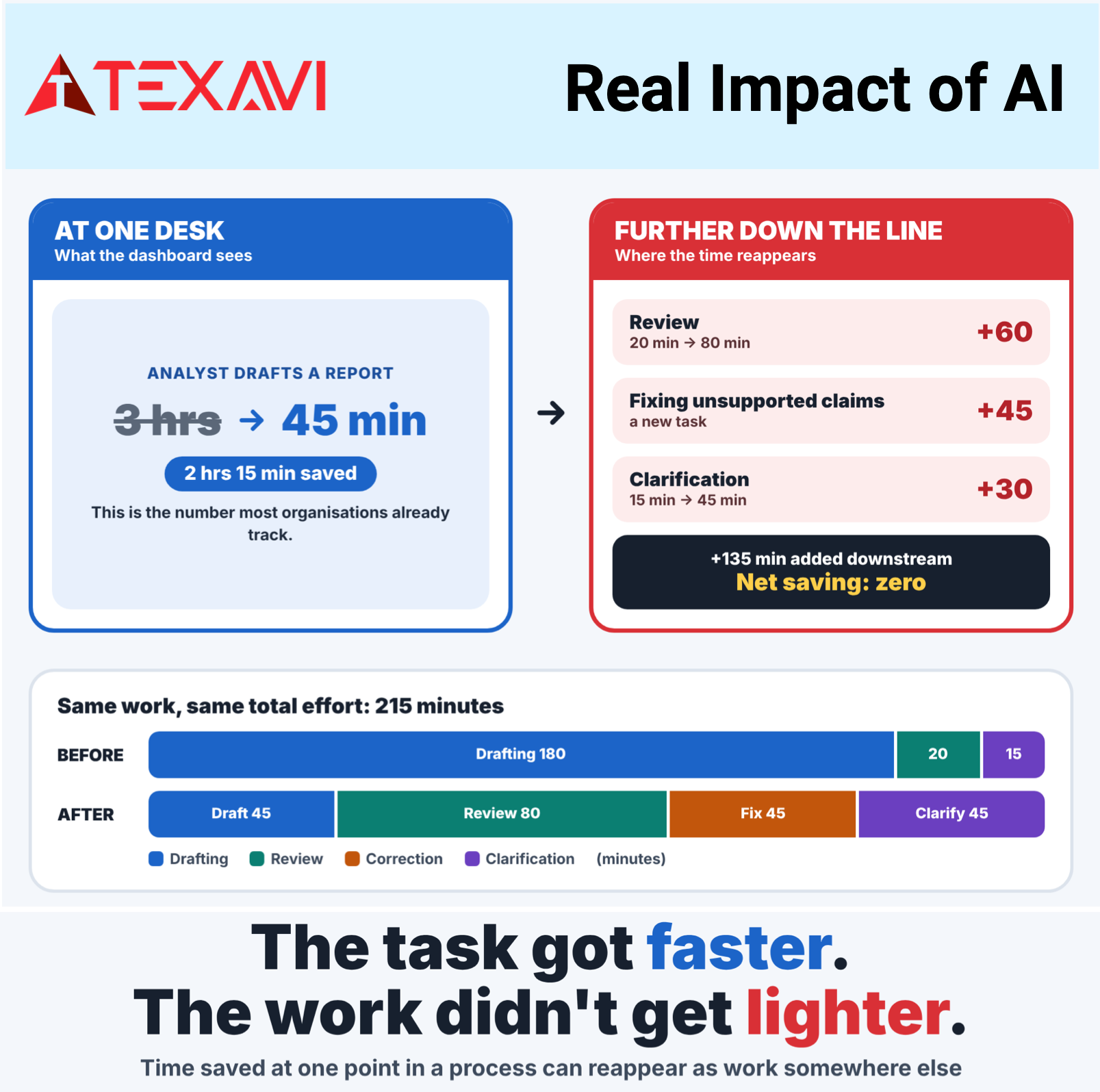
None of this means the technology has failed. It means the unit of measurement is too small. Work does not end when a task leaves the person who performed it. It ends when an outcome has been accepted, acted upon, and, where necessary, checked for consequences. The effort between those points belongs in the calculation. Consider an internal analysis prepared for a management meeting. Before automation, the analyst spends three hours drafting it; a reviewer spends twenty minutes checking it; and the final discussion requires fifteen minutes of clarification. After automation, drafting takes forty-five minutes. That saves two hours and fifteen minutes on the originating task.
Suppose, however, that review now takes eighty minutes, correcting unsupported statements takes forty-five minutes, and clarification takes another forty-five. Those additional activities absorb exactly the time saved in drafting. The figures are illustrative, not findings from a study. They show how a genuine improvement at one desk can disappear when you measure the full process. If the resulting analysis is also less reliable, the organisation may be worse off even though its dashboard shows a faster drafting time.
The Net Workflow Value
This is why I would assess AI-enabled work through what I call Net Workflow Value. It is a practical measurement approach, not a claim to have discovered a universal productivity formula. The idea is to follow a piece of work from its first action to its usable result, recording both the effort removed and the effort introduced.
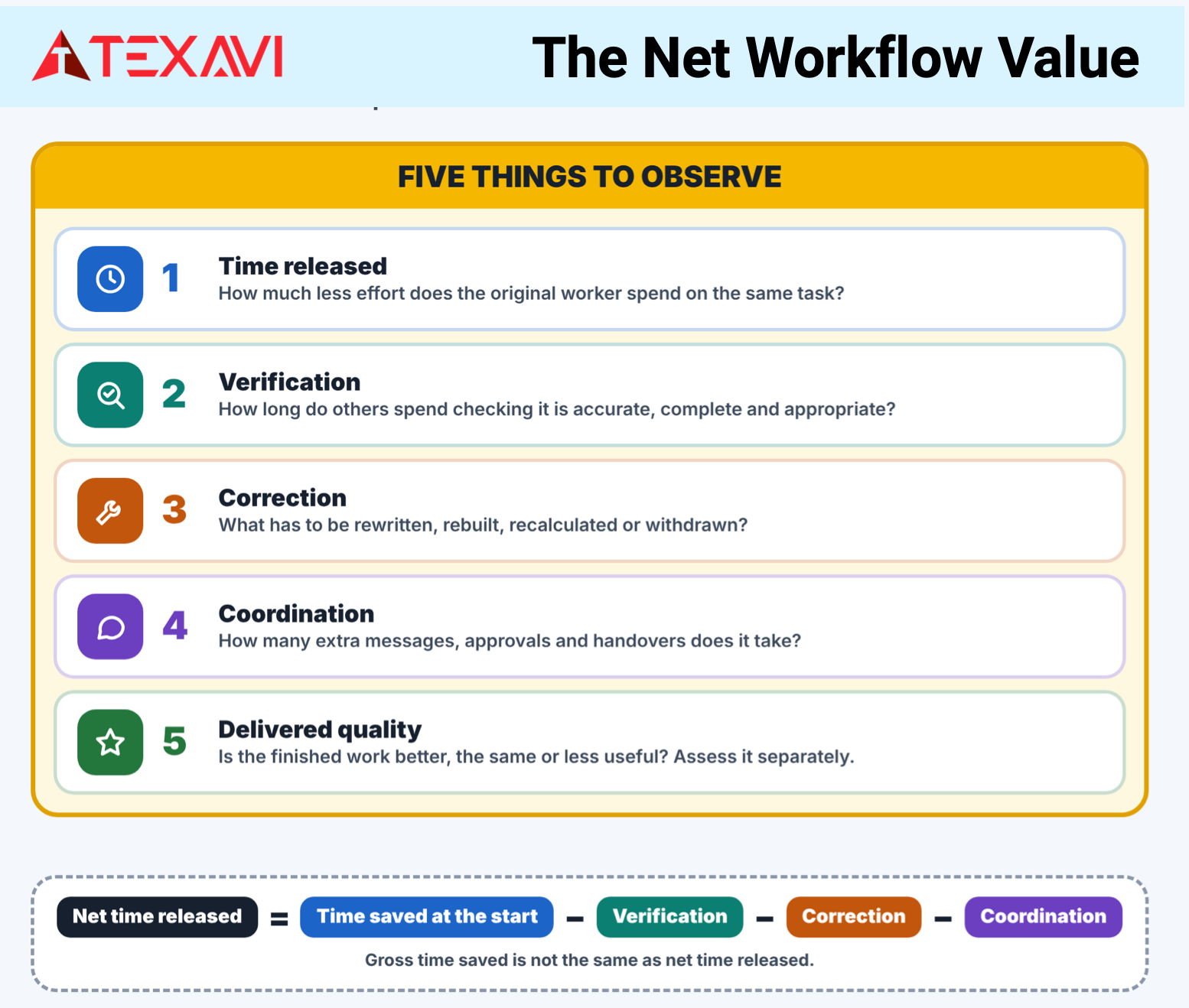
The following five observations matter in this context, let us look at these in greater detail below:
- Time released at the point of use
- Verification
- Correction
- Coordination
- Delivered quality
1. Time released at the point of use
How much less effort does the original worker spend completing the same defined task? This is the figure most organizations already know, although even here the comparison should account for difficulty and volume.
2. Verification
How much time do other people spend checking whether the output is accurate, complete and appropriate? Count routine quality assurance in both the old and new process; only the change belongs in the comparison.
3. Correction
What extra work is required when an output has to be rewritten, rebuilt, recalculated, or withdrawn? The cost is not limited to the person fixing it. A mistake can reopen tasks that several people thought were finished.
4. Coordination
How many additional explanations, messages, approvals, or handovers are needed to get the result used? Co-ordination is easily overlooked because it rarely appears as a separate line in an automation business case.
5. Delivered Quality
Is the completed work better, no worse, or less useful than before? A faster process that produces weaker decisions cannot be credited with the same gain as one that achieves the same standard. Assess quality independently, rather than hiding it inside a convenient number of hours.
Together, these observations make it possible to distinguish gross time saved from net time released. In simple terms, net time released is the reduction in work at the start, minus any additional verification, correction, and co-ordination elsewhere. It should be calculated for comparable completed outputs, not for the number of drafts or suggestions produced. That last detail changes the conversation.
Impacts of AI usage - Real vs. perceived
If a team produces twice as many drafts but approves the same number of finished reports, its output has not doubled. If a service team replies more quickly but receives more follow-up complaints, the initial response time conceals part of the workload. If a software team generates more code but spends longer diagnosing defects, lines produced are a poor measure of progress. The denominator matters. I would look at effort per accepted report, resolved customer issue, approved design, or working software change, depending on the task. What counts as “accepted” should be agreed before measuring, not revised after an attractive result appears.
This approach also avoids blaming the people who use the tools.Someone who is rewarded for producing documents quickly will naturally optimise for speed. The colleague receiving those documents may be judged on accuracy and carry the cost of making them usable. Both people may be doing exactly what their measures encourage. The problem sits in how the organisation has divided responsibility for the outcome.
Productivity transfer - an economic view
A 2025 field experiment reported by the National Bureau of Economic Research illustrates why individual time savings are not the whole story. Across 66 firms and more than 7,000 knowledge workers, access to a workplace AI tool was associated with reduced email time. Still, the researchers did not detect corresponding shifts in the overall quantity or composition of tasks from individual provision. The study does not directly demonstrate the productivity transfer problem. It reinforces the need to distinguish changes in personal activity from changes in work structure.
The same caution applies to the opposite claim: extra review does not automatically make a tool unproductive. Sometimes verification is valuable new work. A system may identify errors that previously went unnoticed, prompting more checking but preventing expensive failures later. A legal team may spend longer examining a draft because it now covers questions that previously received little attention. In those cases, counting review time without measuring the quality improvement would undervalue the change.
Nor should every saved minute be counted as money saved. A worker who completes routine administration sooner may spend the recovered time helping customers, developing skills or dealing with neglected problems. The organisation has gained capacity, but it has not necessarily reduced expenditure. The benefit needs to be described accurately.
Financial gains from saving time
A further distinction exists between workflow value and financial return. Software licences, integration effort, training and ongoing maintenance belong in the latter calculation. A process can release time without repaying its implementation cost, particularly when usage is low. Conversely, an improvement in accuracy may justify the investment even when the labour saving is modest. Keep those questions alongside the workflow measures rather than mixing them into a single, misleading headline figure.
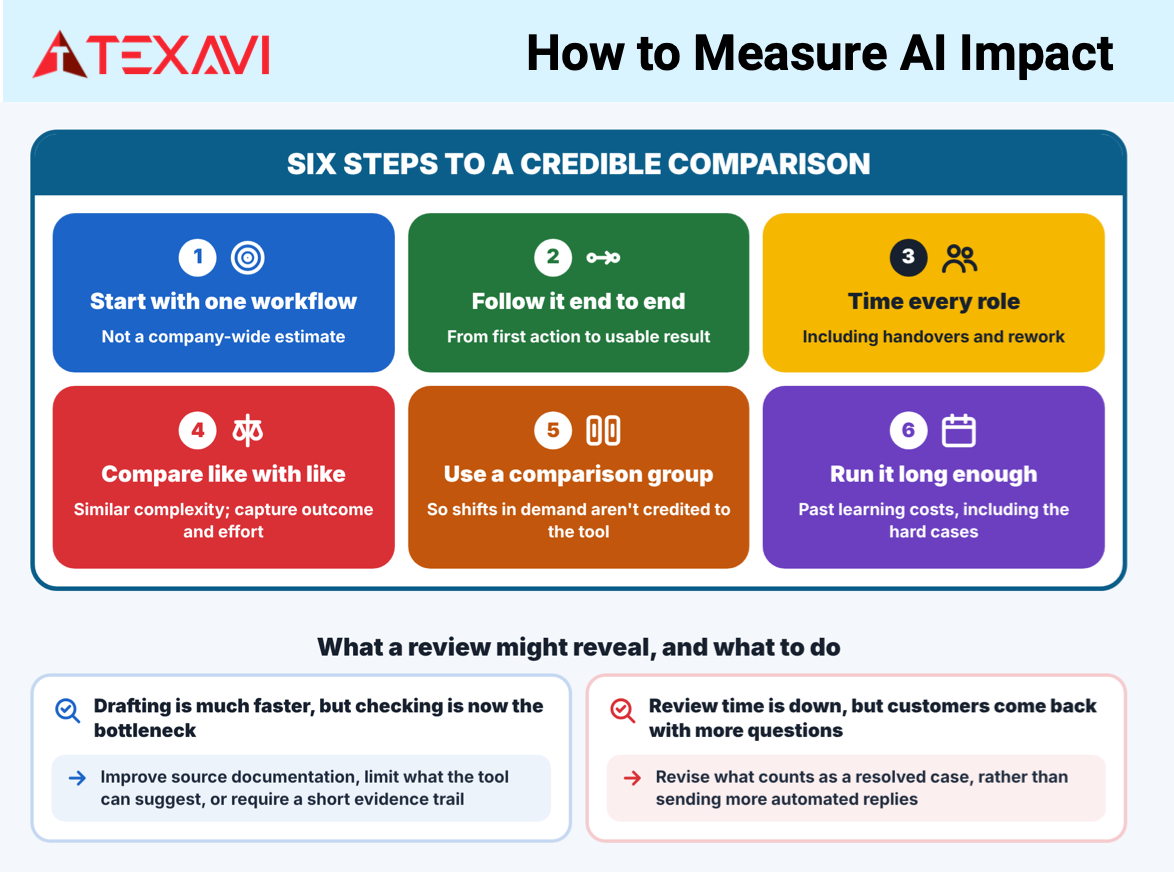
For a credible comparison, I would begin with one workflow, not a company-wide estimate. Follow a representative sample of work before and after a tool is introduced. Record the time spent by each role, including handovers and rework. Compare jobs of similar complexity, and capture the outcome as well as the effort. Where possible, keep a comparison group or test different teams over the same period, so shifts in demand aren't mistaken for the tool's effect.
Productivity and fairness
The measurement should run long enough to separate initial learning costs from routine operation. It should also cover difficult cases, not only the examples that work smoothly in a demonstration. A useful review might reveal that drafting has become much faster, but checking has become the bottleneck. That does not necessarily call for abandoning the tool. It may mean improving source documentation, restricting the types of decisions the system can suggest, or requiring a short evidence trail with each output. Another workflow might show that review time has fallen, but customers are returning with more questions. The right response there may be to revise the definition of a resolved case rather than to increase the volume of automated replies.
Fairness is also a question. When one function claims a productivity gain while another absorbs the costs, recognition and resources can follow the wrong numbers. Teams dealing with errors may appear less efficient, even though they are keeping the broader process functional. Measuring the whole workflow makes that hidden contribution harder to ignore. I do not think every organisation needs an elaborate accounting system to see this. A short study of where work starts, who receives it, what they must do before accepting it, and how often it returns for correction can reveal more than an impressive collection of individual time-saving estimates. The point is not to become suspicious of every efficiency claim. It is to be precise about what has improved.
Conclusion
AI can make particular tasks considerably faster. It can improve quality, widen access to expertise and reduce work that people would rather not repeat. Those gains are worth pursuing. But they should not be declared complete at the moment an output leaves the screen. The proper test is whether the organisation can deliver a useful result with less total effort, fewer avoidable delays or better quality, without quietly making someone else responsible for the unfinished work. When one team saves an hour, the next question should be simple: where did that hour go?
 ® and Analyst Zone® © Since 2017 Texavi Innovative Solutions